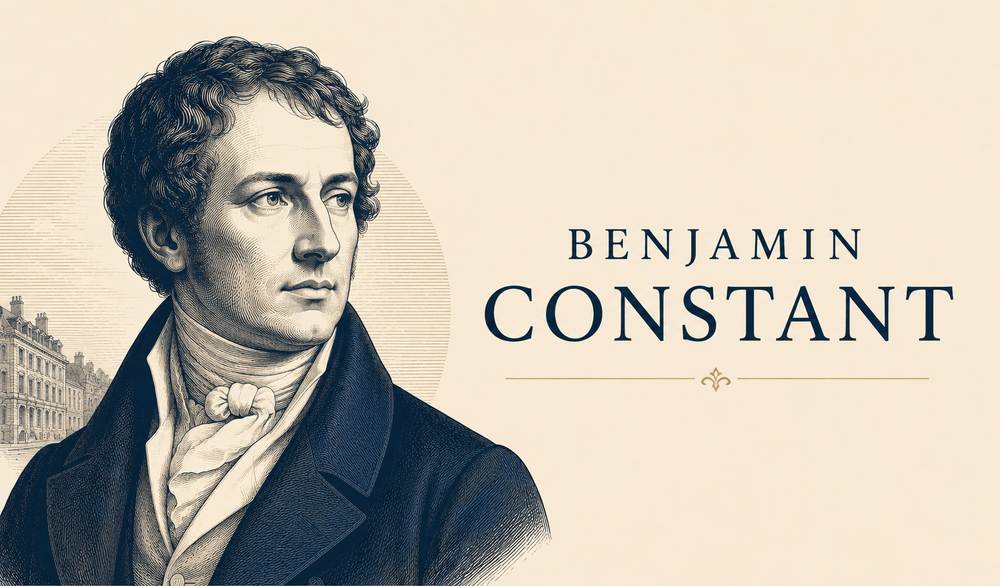
On February 13, 1819, Benjamin Constant addressed an audience at
the Athénée royal in Paris. He was fifty-one. He had lived through
the Revolution, the Terror, the Directory, the Empire, and two
Restorations. He had opposed Napoleon, then helped him draft a
liberal constitution during the Hundred Days. This was no innocent
observer speaking. It was a man trying to understand a political
failure his own generation had been caught in.
Benjamin Constant and the two ways liberty disappears
On February 13, 1819, Benjamin Constant rose to speak at the
Athénée royal in Paris. He was fifty-one. Behind him lay a quarter
century of upheaval: the Revolution, the Terror, the Directory,
the Consulate, the Empire, two Restorations.
He was no neutral witness. He had opposed Napoleon, then rallied
to him during the Hundred Days, going so far as to draft the
Additional Act of 1815, a liberal constitution for an emperor who
would not last. His relationship to power and to liberty was
personally compromised. That is exactly what makes his question
serious.
How could a revolution made in the name of liberty end by crushing
the individual?
His answer began with a distinction.
Two liberties that look nothing alike
In the ancient city-states, liberty meant participation. Voting on
laws in assembly. Holding magistracies. Deliberating with fellow
citizens on public affairs. This was real and intense liberty. But
private independence remained narrow, and could always be
subordinated to the authority of the city.
Constant takes care over a nuance that summaries erase. Athens, he
says, resembled modern societies more than any other ancient city,
because commerce had bred an attachment to individual independence
there. Even so, ostracism still asserted the primacy of the social
body over the individual. Sparta and Rome left almost nothing to
private life.
Modern liberty is something else. It does not consist in deciding
together. It consists in being protected in what one decides for
oneself. Freedom of conscience. Freedom to move. Freedom to
dispose of one's property. Freedom to choose one's work. Freedom
to hold opinions without accounting for them.
Constant does not weigh the two liberties equally
And this is where he is most often misread.
Constant does not place the two liberties on equal footing. For
modern societies, individual independence comes first. The ancient
institutions that sacrificed that independence are, to him,
inadmissible in our world.
But he immediately rejects the opposite error. That independence
cannot survive without political liberty. Without representation.
Without supervision of those who govern. Political liberty, he
argues in substance, is the guarantee of individual liberty. Not
its rival. Its condition.
Moderns do not need to govern continuously as the ancients did.
They need to watch those who govern, judge their conduct, replace
them, and never treat representation as political retirement.
The error was not Rousseau's alone
Rousseau alone is often blamed for the intellectual matrix of the
Terror. Constant is more precise, and fairer.
In Constant's reading of Rousseau, the general will raised into
absolute sovereignty prepares the submission of the individual.
But Constant treats Rousseau with respect: a genius, he says,
moved by the purest love of liberty, whose error was to transpose
into the modern world a collective sovereignty belonging to
another age.
His harshest judgment falls elsewhere. It falls on the abbé de
Mably, whom he calls "a hundred times more extreme" than Rousseau.
Mably, Constant writes, wanted citizens "completely subjugated so
that the nation might be sovereign," the individual "enslaved so
that the people might be free." He disliked even Athens, too free
for his taste. He preferred Sparta.
There is the real adversary: not a misplaced love of liberty, but
a love of constraint dressed up as love of the people.
The second warning, the one liberals forget
Constant's warning runs in two directions. The first is familiar.
A collective power calling itself sovereign can invade private
life in the name of the people. This is the Jacobin danger, the
danger of the Terror, and the whole lecture is often assumed to
stop there.
The second danger is more uncomfortable, especially for those who
invoke individual liberty.
Moderns, absorbed in work, family, comfort, and private enjoyment,
may gradually surrender political liberty to representatives and
administrators. Power then offers them a bargain: tend to your own
happiness, we will handle the rest. Just obey and pay. And the
citizens accept, because politics now asks so little of them.
This is probably the most contemporary passage in the lecture.
Constant states it coldly. There are two ways to lose liberty.
Letting the collective absorb the individual. And letting the
individual desert the collective sphere to those who hold power.
The second is gentler. It produces no spectacular victims. That is
why it is harder to see.
What is at stake now
The 1819 lecture is not a relic. It is a tool — provided it is not
distorted.
Not all regulation is "the liberty of the ancients." Ancient
liberty, in Constant, means direct participation in a collective
sovereignty that leaves little room for private independence. A
modern rule can contradict modern liberty without reviving the
ancient kind. Precision matters here, or the analogy becomes a
gimmick.
But the danger he described remains recognizable. When a ministry
defines school curricula in such detail that little room is left
for teachers, schools, or families, it lets collective authority
enter a sphere that modern individuals regard as their own. When
incumbent institutions alone decide who may enter a profession,
collective authority becomes a protection against competition.
The real political question — the one Constant poses and parties
avoid — is not "more or less state." It is: for which decisions is
the collective entitled to substitute itself for the individual,
and at what point does the individual, by falling silent, abandon
the liberty that protects him?
Until that double question is asked, the debate runs in circles.
We talk about rights without the duties of vigilance that keep
them. We invoke liberty without saying which kind, or how it is
lost.
Constant said it plainly. Liberty does not die in one way only. It
dies when it is crushed, and it dies when people stop watching
over it.
[1] Benjamin Constant, The Liberty of the Ancients Compared with
that of the Moderns, lecture at the Athénée royal de Paris,
February 13, 1819 (full text; passages on Athens, ostracism,
Rousseau, Mably "a hundred times more extreme," and the
closing call to combine the two liberties).
[2] Biographical context: Constant and the Additional Act of 1815
(Hundred Days); born October 25, 1767, hence 51 in February
1819.