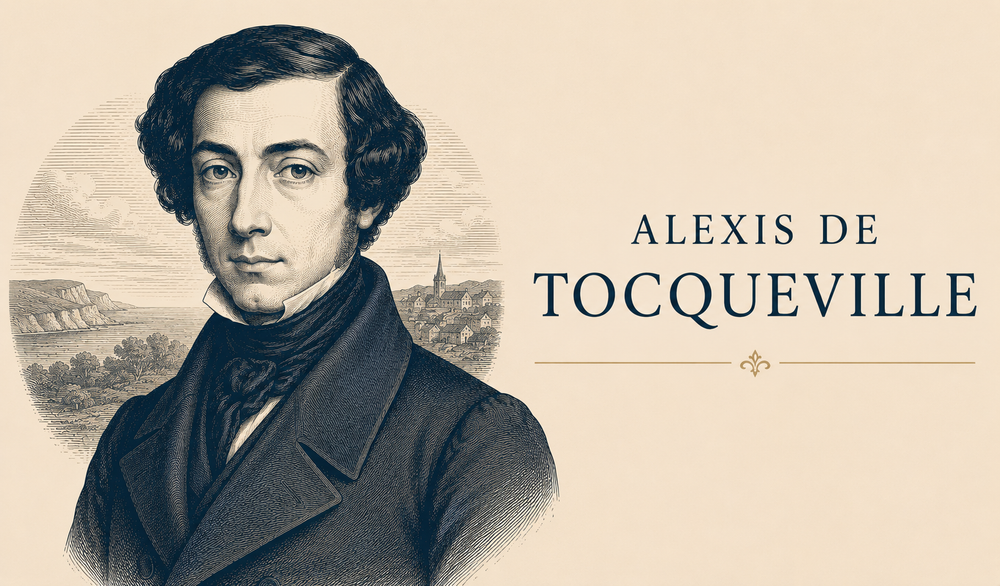
On May 9, 1831, two young French magistrates landed at Newport,
Rhode Island, after thirty-seven days at sea. Their destination
had been New York; wind and dwindling provisions decided
otherwise. One of them was twenty-five. His name was Alexis de
Tocqueville. His official task: study American prisons. His real
ambition: understand what liberty becomes once equality settles
in. Two centuries later, both of his questions still hold.
What Tocqueville saw: the same democratic danger,
two unequal defenses
At eight in the evening on May 9, 1831, a ship dropped anchor in
the outer harbor of Newport, Rhode Island. Aboard were two young
French magistrates, worn down by thirty-seven days at sea. Their
destination had been New York. Contrary winds and a shortage of
provisions forced an early landing. One of them was twenty-five.
His name was Alexis de Tocqueville.
His official mission was to study the American penitentiary
system for the French government. His private ambition was
larger. He wanted to understand what democracy would become, and
why equality had produced such different political habits on the
two sides of the Atlantic.
He spent nine months traveling through the young republic. He
returned with no simple verdict, but with a distinction that
still matters: democratic societies tend toward centralization,
and institutions and habits can either accelerate that tendency
or resist it.
Two centralizations, not one
Tocqueville is often cited as an enemy of the central state. That
is inaccurate, and the nuance is decisive.
He distinguished two things. Governmental centralization gathers
the decisions concerning the general interests of the nation. He
did not reject it. Administrative centralization subjects local
and particular affairs to the center as well. That is the one he
judged destructive, because it deprives citizens of the
apprenticeship of liberty.
A citizen who has never administered his town, never sat on a
jury, never run an association, unlearns autonomy. He becomes an
administered subject. That is precisely what Tocqueville feared
for democracies: not violent tyranny, but the gradual erosion of
the capacity to act without the state.
France did not invent its centralization in 1789
It would be a mistake to blame French centralism on the
Revolution alone. Tocqueville traced it further back. He devoted
the whole of The Old Regime and the Revolution to showing that
the monarchy had already centralized administration. The
Revolution destroyed many inherited intermediate bodies while
preserving and reinforcing the centralizing machinery. Napoleon
completed the architecture.
This is a story of continuity, not rupture. The French citizen
expects from the state what he cannot obtain alone — not because
a decree ordered it, but because three centuries of institutions
taught him to.
In the United States, Tocqueville observed the opposite. The
federal government was nearly invisible in daily life. Towns
administered themselves. Associations multiplied. Local courts
settled disputes. The central state existed but did not fill the
space.
What the index sees, and what it does not
Two centuries later, the 2025 edition of the Fraser Institute's
Economic Freedom of the World index, using data from 2023, ranks
the United States fifth and France forty-fourth among 165
jurisdictions.
The index is not a measure of Tocquevillian liberty. It cannot
count local initiative, civic associations, or the habit of
acting without first turning toward the state. This must be said
plainly, all the more so because the Fraser Institute builds its
index on an explicitly liberal conception of economic freedom.
It is not a neutral statistical producer.
But it captures part of the institutional contrast. And the
detail is more instructive than the overall ranking. France
ranks ninth in the world for freedom to trade internationally,
ahead of Germany, and twenty-sixth for its legal system and
property rights. These are not the scores of a country failing
everywhere.
What drags its position down is a single area: the size of
government, where it ranks 156th. Regulation follows, more
moderately, at 45th.
Tocqueville did not lack an index. He was measuring something an
index can only half see.
Prosperity: strong association, cautious claim
The Fraser report shows a striking gap. Average GDP per capita in
the freest quartile reaches $66,434 in international dollars,
against $10,751 in the least free quartile. Life expectancy there
is 79 years, against 62.
The association is striking, and observed year after year. It is
not, by itself, proof that every difference in income or
longevity is caused by the index score. Level of development,
general institutional quality, history, geography, political
stability — too many factors are entangled to settle causation.
Saying so does not weaken the argument. It strengthens it,
because a skeptical reader cannot turn it against us.
The mirror, both ways
The comparative method has a virtue that French domestic debate
lacks: it forces you out of national self-evidence. What seems
inevitable here — administrative tutelage, the single window,
decision by decree — is inevitable nowhere.
When France organizes access to higher education through a
centralized national platform that coordinates rankings produced
by individual institutions and applies national allocation rules,
it is not just doing administration. It is reproducing an
architecture. When it regulates professions through orders, when
it reforms universities by decree rather than by competition
between institutions, it reproduces the same one.
America made other choices. Not perfect ones. Tocqueville noted
their flaws himself: the tyranny of the majority, social
conformity, the pressure of opinion. And he foresaw the American
drift. He thought it would be held back by local institutions,
associations, federalism, the jury, the legal profession,
religion, and what later translations would call the "habits of
the heart." Not one safeguard. Several.
The 2025 Fraser report includes a modeling exercise estimating
that the tariffs introduced that year would push the United
States from 56th to 76th in trade freedom, and nearly out of the
overall top ten. An estimate, not an observation. The boundary
between the two models is real. It moves.
It is not inevitable
Two examples beat a list. Sweden, whose public spending peaked
around 67% of GDP in 1993, brought it down to roughly 52% by the
early 2000s and toward 49% today, without dismantling its welfare
state. New Zealand carried out a radical reform of its public
sector in the 1980s — its record is still debated, but it proves
an administration can be rethought from the ground up.
What Tocqueville understood, and what French debate keeps
avoiding, is that liberty is not a natural state to be preserved.
It is a construction to be maintained, or left to erode.
Intermediate bodies, local autonomy, competition between
institutions: these are not liberal ornaments. They are the
mechanisms by which a free society reproduces itself.
Where the economic index and Tocqueville meet is on a single
question. How much space does the state still leave for
individuals and institutions to act without it?
The answer has not changed since 1831. What has changed is that
we can now measure part of it.
[1] Fraser Institute / Cato Institute, Economic Freedom of the
World 2025 (2025 edition, 2023 data: France 44th, US 5th,
Germany 15th, of 165 jurisdictions; French sub-rankings:
size of government 156th, legal system & property 26th,
sound money 33rd, trade 9th, regulation 45th; GDP and life
expectancy quartiles; tariff modeling US 56th→76th).
[2] Tocqueville, Democracy in America, vol. I (1835) and vol. II
(1840); The Old Regime and the Revolution (1856).
[3] Tocqueville correspondence / Letters from America (Newport
landing, May 9, 1831, 37-day crossing).
[4] OECD public spending data (Sweden: peak ~67% of GDP in 1993,
~52% early 2000s, ~49% recently).